

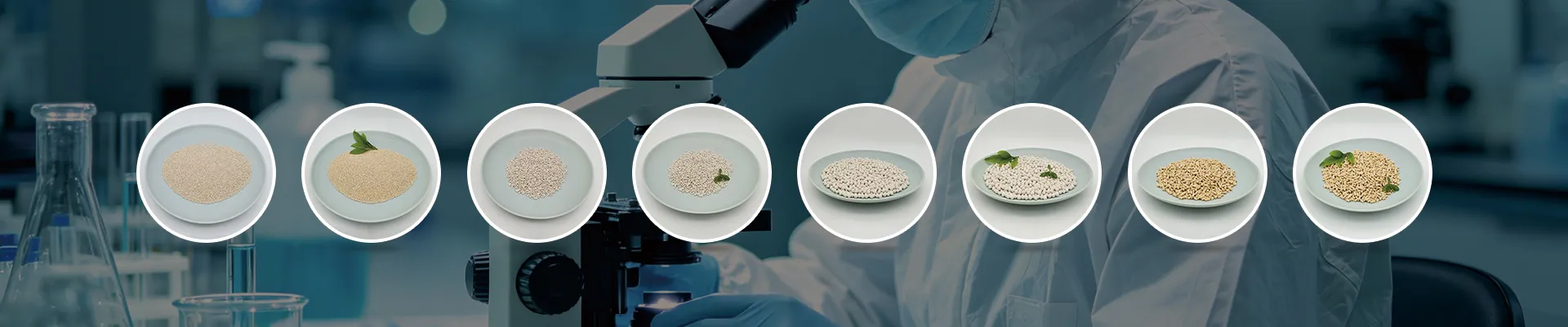
Water and impurities present in solvents are negative factors in industrial processes, and they need to be removed by zeolite molecular sieves, which is known as solvent drying or solvent treating. With their precise pore sizes and chemical stability, molecular sieves have become irreplaceable and highly efficient materials for solvent treating, particularly in the fine chemical and pharmaceutical industries.
Typical Problems In Solvent Treating
Industrial solvents often contain impurities, such as excessive water (most common and most influential), acidic or alkaline substances, organic matters, and impurity gases (carbon dioxide, nitrogen, and hydrocarbons) introduced after solvent recovery, etc.

The impacts of these water and impurities on industrial processes include (but not limited to): interfering with chemical reactions, degrading material properties, posing environmental and health risks. So they must be removed to satisfy process requirements, and to prevent compromises in product quality and solvent recycling.
Why Molecular Sieve Is Irreplaceable?
Efficiency: Molecular sieves possess extremely high adsorption capacity and adsorption rate, enabling them to effectively remove water from solvents within a short period of time, and thereby improving drying efficiency.
Selectivity: Molecular sieves selectively adsorb impurity molecules without significantly affecting other components in the solvent. This selective adsorption property gives molecular sieves unique advantages in solvent treating processes.
Stability: As an excellent adsorption material, molecular sieves exhibit high thermal stability and chemical stability, and can maintain stable adsorption performance under various operating conditions and kinetic circumstances.
Renewability: Molecular sieves are an environmentally friendly material, and their adsorption performance can be restored through regeneration process, allowing for recycling and thus reducing economic costs.
Molecular Sieves For Solvent Treating
Type 3A Zeolite Molecular Sieve: Suitable for drying small molecule polar solvents such as ethanol, methanol, acetone, DMF, THF, etc. It can also be used for drying solvents such as acetonitrile and 2-propanol.
Type 4A Zeolite Molecular Sieve: It is a commonly used and cost-effective desiccant with strong absorption capacity. It is suitable for drying medium polar solvents such as chloroform, dichloromethane, ether, ethane and etc.
Type 5A Zeolite Molecular Sieve: It can absorb water, carbon dioxide, hydrogen sulfide, and small molecules such as linear alkanes. It is suitable for treating mixed solvents, removing polar impurities, and separating hydrocarbons.
Type 13x Zeolite Molecular Sieve: It has a larger pore size and higher adsorption capacity, and is suitable for polar and non-polar solvent treatment. It is widely used for removing water and impurities from solvents such as aromatic and alkanes.