

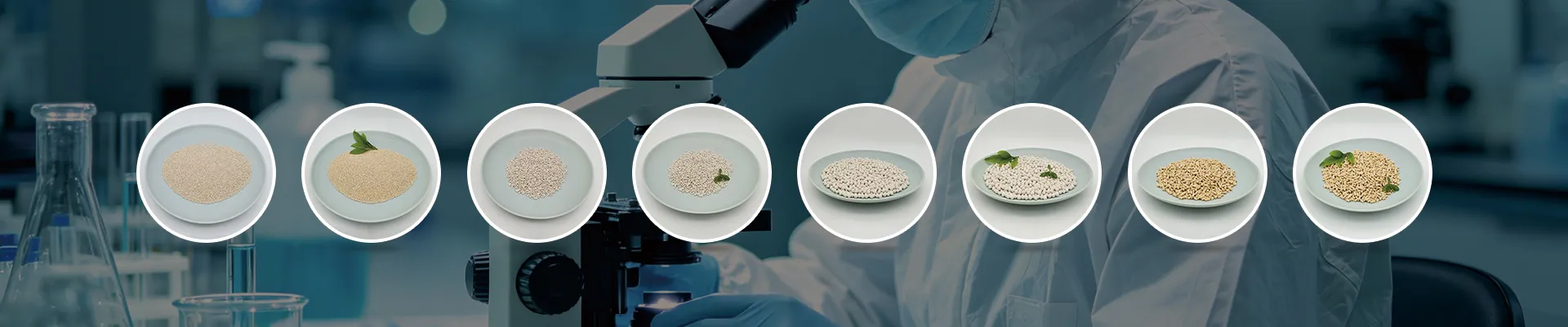
Linear and branched paraffins can be separated by zeolite molecular sieve. Paraffins have different applications and values in petrochemicals and downstream fine chemicals, and the separation of linear and branched paraffins can achieve higher industrial utilization efficiency and economic benefits.
Why To Separate Linear And Branched Paraffins?
Linear paraffins (also known as normal alkanes or n-paraffins) and branched paraffins (also called isomeric alkanes or i-paraffins) are important raw materials in the petrochemical industries, and their separation is of great significance for the production of high quality fuels and chemical raw materials.
For linear paraffins, they have higher boiling points and a lower octane numbers (anti-explosion performance). They are more suitable as chemical raw materials, such as cracking to produce ethylene and propylene, synthesizing surfactants, preparing normal alkane solvents and specialty chemicals, etc.

For branched paraffins, they have lower boiling points, higher octane numbers, and more complete combustion. They are more suitable as fuel components, such as gasoline blending to increase octane numbers, aviation fuel, and clean fuel, etc.
How To Separate Linear And Branched Paraffins?
As is known, the critical diameters of linear paraffin molecules are 4.9 angstroms, while the diameters of branched paraffin are greater than 5 angstroms. So we can use the steric effect of type 5A zeolite molecular sieves to separate linear and branched paraffins.
The normal paraffins (such as n-butane and n-hexane) have linear structures and are smaller and thinner in size, so they can enter the pores of type 5A molecular sieve. And isomeric paraffins (such as iso-butane and iso-hexane) have branched structures, larger molecular volumes or irregular shapes, and cannot enter the pores of type 5A molecular sieve.
When the paraffin molecules enter the molecular sieves, normal paraffins are adsorbed by the 5A molecular sieves; isomeric paraffins cannot enter the pores and remain in the gas or liquid phase. In this way, normal paraffins and isomeric paraffins can be separated by the 5A molecular sieves.
Molecular Sieves For Separating Linear And Branched Paraffins
Obviously, type 5A zeolite molecular sieve is ideal for separating linear and branched paraffins. The pore size of 5A molecular sieve is just about 5 angstroms. Due to their large size and high steric hindrance, branched paraffins cannot enter the pores of 5A molecular sieve and thus will not be adsorbed.
Using type 5A zeolite molecular sieve to separate linear and branched paraffins, can produce high purity linear paraffin feedstocks (such as n-pentane and n-hexane) and also improve isomerization selectivity.