

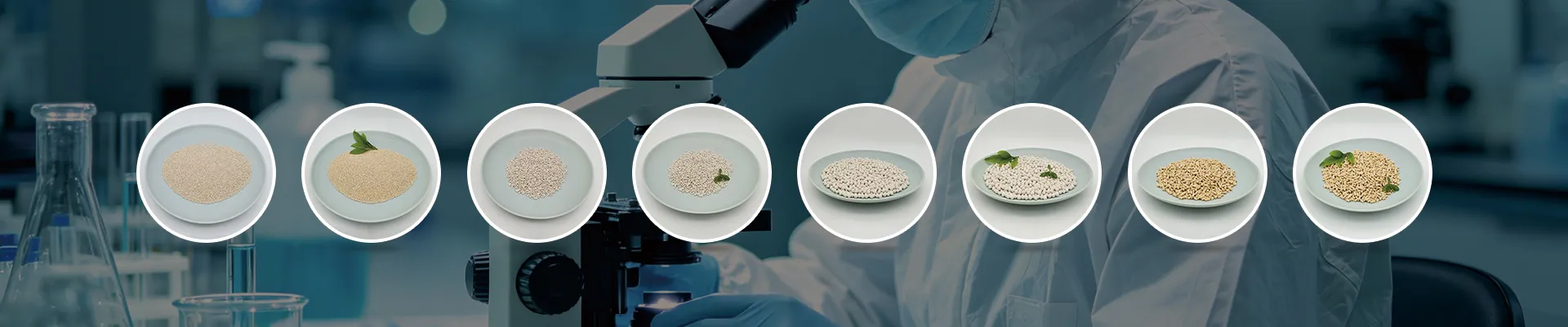
In ethanol dehydration, zeolite molecular sieves are mainly used to overcome the azeotropic point limitation, and produce anhydrous ethanol or high purity ethanol through liquid-phase or gas-phase processes. This technology is widely used in bioethanol, medicine, food and other chemical industries.
Why Does Ethanol Need To Be Dehydrated?
In the production process, water is inevitably produced when ethanol is obtained. Ethanol forms an azeotropic mixture with water, which cannot exceed a concentration of 95.6% under normal distillation conditions.
And in industrial applications, high purity ethanol is often a necessary requirement. Therefore, ethanol dehydration or ethanol purification is needed to break the azeotropic limits and acquire a more refined final product.

Zeolite Molecular Sieve For Ethanol Dehydration
Type 3A zeolite molecular sieve has been highlighted in ethanol dehydration, it preferentially adsorbs polar water molecules and has almost no adsorption to ethanol molecules, and it is the first choice for ethanol dehydration.
The diameter of a water molecule is approximately 2.8 Å, while the diameter of an ethanol molecule is about 4.4 Å, so the micropores (with a diameter of about 3Å) of the 3A zeolite molecular sieves allow water molecules to enter the adsorption channels, but repel larger ethanol molecules. Therefore, the 3A molecular sieve can selectively adsorb water, ultimately obtaining high purity ethanol.
Molecular Sieve Ethanol Dehydration Process
Using molecular sieve to remove water to PPM level is currently one of the most mature and efficient technologies in ethanol dehydration industry. Compared with other ethanol dehydration processes, molecular sieve is of great economic and environmental benefits.
TSA dehydration process: Liquid phase ethanol passes through the adsorption bed, heating for desorption and regeneration. It is suitable for small and medium-scale applications, and is commonly used in systems with batch operations and long production cycles.
PSA dehydration process: Gas phase ethanol enters the adsorption system under pressurization. During depressurization, the water is released, regenerating molecular sieve. It is suitable for large-scale industrial fuel ethanol dehydration systems that require continuous production.
Molecular Sieve Advantages For Ethanol Dehydration
Technological superiority: Molecular sieve dehydration unit has the strengths of simplicity and low installation cost. The molecular sieves are easy to regenerate, and have a long service life, which can enable continuous production.
Operation and maintenance: Molecular sieve dehydration unit can be designed with dual towers or multiple towers for alternate adsorption and regeneration. It features automatic control, simple operation and easy maintenance.
Purity and efficiency: The purity of final product ethanol can reach 99.5%~99.9% (anhydrous ethanol). Molecular sieve dehydration technology has become the industrial standard for anhydrous ethanol production, promoting green upgrades in the biofuel and chemical industries.
Economical and environmental friendliness: The entire process contains no toxic additives, no waste discharge, which saves energy and significantly improves dehydration efficiency compared with traditional methods.