

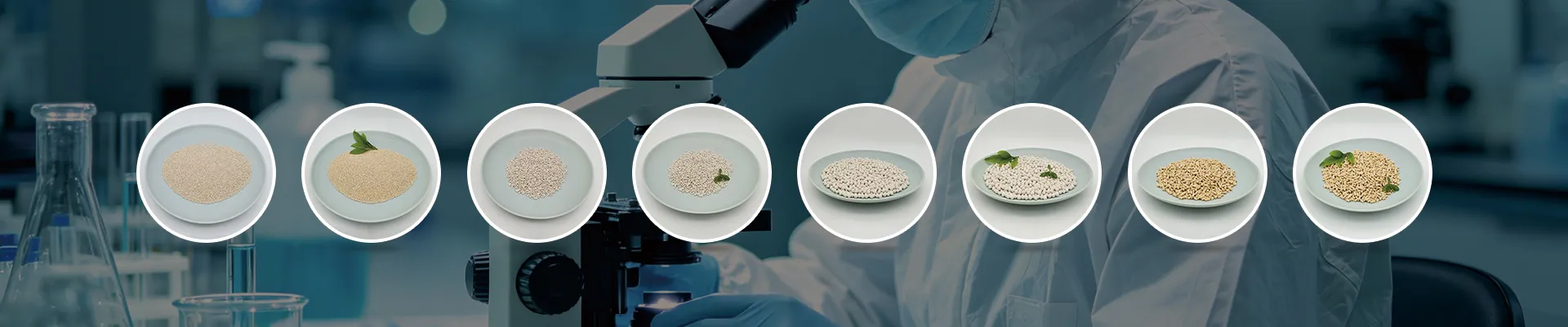
Zeolite molecular sieves are crucial in the pre-purification process of the cryogenic air separation industry. The air stream must passes through the molecular sieve bed before entering the main air separation unit, to remove impurities that may interfere with the cryogenic process or affect product quality.
What Is Cryogenic Air Separation Technology?
Cryogenic air separation technology is based on the differences in boiling points of constituent gasses, first cools the air to an extremely low temperature (lower than the boiling point of each gas component), usually below -180°C, and then uses the boiling point difference to distill and separate the gases.
Cryogenic air separation technology is widely applied in steel, chemical, electronics, medical, aerospace and other fields. It is the core method for industrial gas separation, and is currently the most mature and efficient method for industrial production of oxygen, nitrogen, argon and rare gases.

Cryogenic Distillation Air Separation Process
Cryogenic distillation air separation process usually includes the following six steps:
Air compression: Pressurize the air by multiple stages of compressors, to provide the necessary pressure for air cooling and subsequent separation. The pressure range can be 0.5Mpa~0.8Mpa (normal pressure device), or 3Mpa~6Mpa (high pressure device).
Pre-cooling: Lower the air temperature to the liquefaction point by a cooler (usually cooling water or refrigerant), approximately 5°C to 10°C, reducing the energy requirement of subsequent cryogenic air separation.
Pre-purification: Use adsorption towers (loaded with molecular sieves, activated alumina and other adsorbents) to remove impurities such as moisture, carbon dioxide and hydrocarbons, preventing low-temperature freezing and clogging of equipment, ensuring the safety of the cryogenic process.
Deep cooling: The purified air exchanges heat with the cold air flow, gradually cooling down to the liquefaction temperature, approximately -170°C to -180°C, and some of the gas in the air are liquefied.
Distillation separation: The high pressure column separates out the oxygen-rich liquid and the nitrogen-rich liquid. High-purity oxygen and nitrogen are obtained from the low pressure column after further distillation. And the argon gas is led out from the middle of the low pressure column.
Gas extraction and storage: Oxygen, nitrogen and argon are reheated to gas and and then output. Some are liquefied for storage, such as liquid oxygen and liquid nitrogen. However, high purity oxygen (>99.5%), nitrogen (>99.9%), and argon (>99.9%) are available upon request.
Molecular Sieves For Cryogenic Air Separation
13X APG Zeolite Molecular Sieve: It is specially developed for air cryogenic air separation industry, applicable to any size of air cryo-separation devices. 13X APG has a strong selective adsorption capacity for water and carbon dioxide.
13X HP Zeolite Molecular Sieve: It has high oxygen and nitrogen separation performance and sufficient oxygen production rate, which is mostly used for oxygen generating units to implement oxygen and nitrogen separation, making industrial and medical oxygen enrichment.
13X APG III Zeolite Molecular Sieve: It is an advanced type of 13X APG. The adsorption performance of zeolite 13X APG III is 60%~70% higher than that of 13X APG. Even at low carbon dioxide conditions, the adsorption capacity of 13X APG III still performs well.
13X APG V Zeolite Molecular Sieve: The adsorption performance of 13X APG V is more than twice that of 13X APG, and more than 1.4 times that of 13X APG III. 13X APG V molecular sieve is a leading material in the cryogenic air separation industry, and its performance indicators are far superior to its predecessors.